
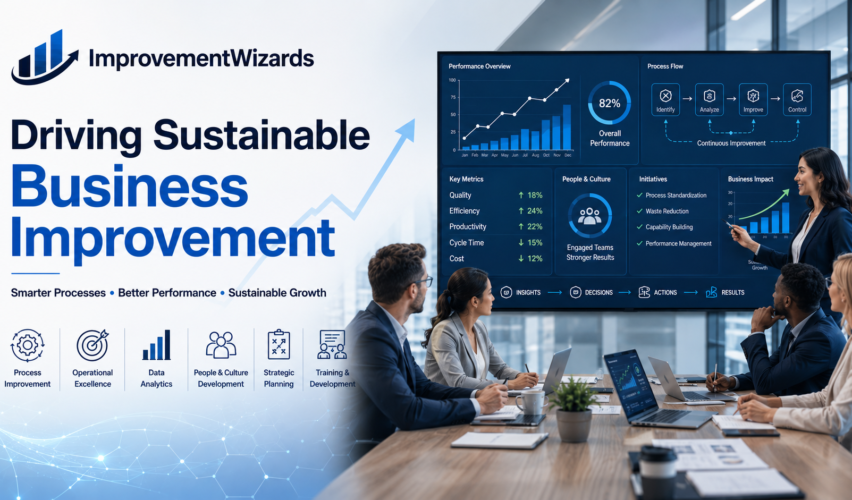
In today’s rapidly changing business environment, organizations across industries are continuously looking for better ways to improve efficiency, strengthen performance, manage resources effectively, and create long-term value. Sustainable improvement is no longer limited to reducing costs or fixing individual problems; it involves creating a culture where processes, people, technology, and business objectives work together toward measurable and lasting results.
Professional improvement services can play an important role in this journey by helping organizations understand their current performance, identify opportunities, develop practical solutions, and build the capabilities required to sustain progress.
A Comprehensive Approach to Business Improvement
Effective improvement begins with understanding how work is currently performed. Every organization has processes that influence productivity, quality, customer experience, operational costs, and overall performance. When these processes are carefully evaluated, organizations can identify unnecessary complexity, inefficiencies, bottlenecks, variation, and opportunities for optimization.
A structured improvement approach brings together analysis, practical problem-solving, strategic thinking, and implementation support. This allows organizations to move beyond short-term fixes and develop solutions that can deliver sustainable improvements over time.
Process Improvement and Operational Excellence
Process improvement is at the heart of many successful transformation initiatives. Well-designed processes help organizations reduce waste, improve consistency, shorten cycle times, increase productivity, and deliver greater value to customers.
Operational excellence takes this concept further by connecting process performance with broader organizational objectives. It encourages organizations to continuously evaluate how work is performed and how resources are utilized, while creating systems that support ongoing improvement.
Approaches such as Lean thinking, Six Sigma methodologies, process analysis, root-cause problem solving, process mapping, and continuous improvement can provide organizations with practical frameworks for addressing operational challenges.
Quality and Performance Improvement
Quality is an essential component of sustainable business performance. Consistent quality helps organizations reduce errors, rework, defects, delays, and customer dissatisfaction.
Performance improvement initiatives can support organizations in establishing meaningful measures, identifying performance gaps, analyzing their underlying causes, and implementing improvements based on reliable information rather than assumptions.
By combining quality-focused thinking with performance measurement and structured problem solving, organizations can develop stronger and more reliable operating systems.
Data, Analytics, and Better Decision-Making
Modern improvement initiatives increasingly depend on data. Organizations generate large amounts of information through their operations, customer interactions, financial activities, and internal processes. The challenge is turning that information into useful insight.
Data analysis, performance measurement, reporting, dashboards, and analytical techniques can help decision-makers understand trends, identify variation, recognize improvement opportunities, and monitor results.
A data-driven approach also creates greater transparency and makes it easier to evaluate whether improvement initiatives are producing the intended outcomes.
Training, Coaching, and Capability Development
Long-term improvement depends not only on processes but also on people. Organizations need employees and leaders who understand improvement methodologies and know how to apply them in practical situations.
Training and development programs can build knowledge in areas such as continuous improvement, problem solving, process optimization, quality management, analytical thinking, and operational excellence.
Coaching and mentoring can complement formal training by helping teams apply these concepts to real-world situations. This approach encourages knowledge transfer and helps organizations develop internal improvement capabilities rather than relying entirely on external expertise.
Workshops and Collaborative Improvement
Some of the most effective improvement opportunities emerge when people who understand different parts of an organization work together.
Facilitated workshops can bring teams together to analyze processes, define challenges, explore potential solutions, prioritize opportunities, and create practical action plans.
Collaborative improvement also helps create stronger ownership. When employees participate in identifying problems and developing solutions, they are more likely to understand the purpose of change and contribute to sustaining the results.
Strategic and Organizational Improvement
Operational improvements are most effective when they support broader business goals. Strategic improvement therefore involves connecting organizational priorities with measurable initiatives and practical execution.
This may include reviewing existing strategies, identifying performance gaps, establishing priorities, developing improvement roadmaps, and aligning teams around common objectives.
A strong connection between strategy and execution helps organizations ensure that improvement activities are focused on areas that create meaningful business value.
Supporting Transformation and Sustainable Change
Business transformation is rarely achieved through a single project. Sustainable transformation requires a combination of process improvement, leadership involvement, employee engagement, effective communication, measurement, and ongoing follow-through.
Change management and implementation support can help organizations move from planning to execution while reducing resistance and maintaining alignment across teams.
The objective is not simply to introduce a new process or methodology, but to create an environment in which improvement becomes part of the normal way of working.
A Practical and Measurable Improvement Mindset
Successful improvement should ultimately produce measurable results. Depending on organizational priorities, these results may include improved productivity, better quality, reduced waste, shorter cycle times, improved customer experience, stronger operational performance, or more effective use of resources.
A practical improvement methodology combines structured analysis with real-world implementation. Instead of applying the same solution everywhere, improvement initiatives should consider the organization’s objectives, existing processes, people, resources, and operating environment.
Building a Culture of Continuous Improvement
The most resilient organizations understand that improvement is an ongoing journey. Markets change, customer expectations evolve, technologies develop, and business requirements shift. As a result, organizations must continually evaluate and improve the way they operate.
A culture of continuous improvement encourages teams to ask important questions:
- What can be done more effectively?
- Where are resources being wasted?
- What causes recurring problems?
- How can quality and consistency be improved?
- Which activities create the most value?
- How can data support better decisions?
- What capabilities do teams need for future challenges?
When these questions become part of everyday business thinking, improvement moves beyond individual projects and becomes an organizational capability.
Conclusion
Sustainable business improvement requires more than isolated solutions. It requires a structured approach that brings together process improvement, operational excellence, quality, analytics, training, coaching, workshops, strategic thinking, change management, and implementation.
Organizations that invest in these capabilities can create stronger processes, more capable teams, better decision-making systems, and a foundation for continuous improvement.
In an increasingly competitive business landscape, the ability to improve consistently can become one of the most valuable organizational capabilities—helping businesses adapt, perform more effectively, and create sustainable value over the long term.